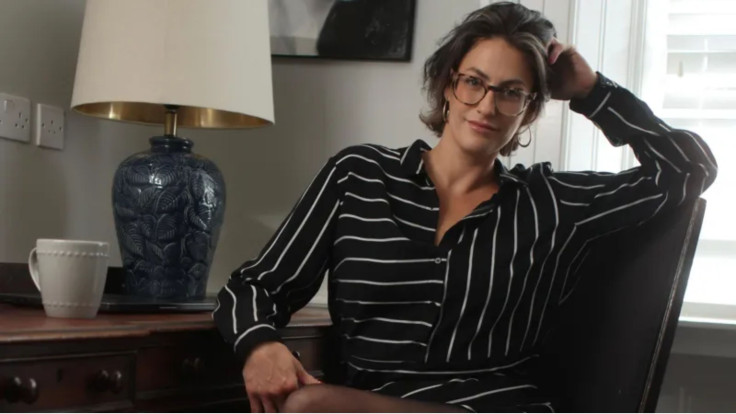

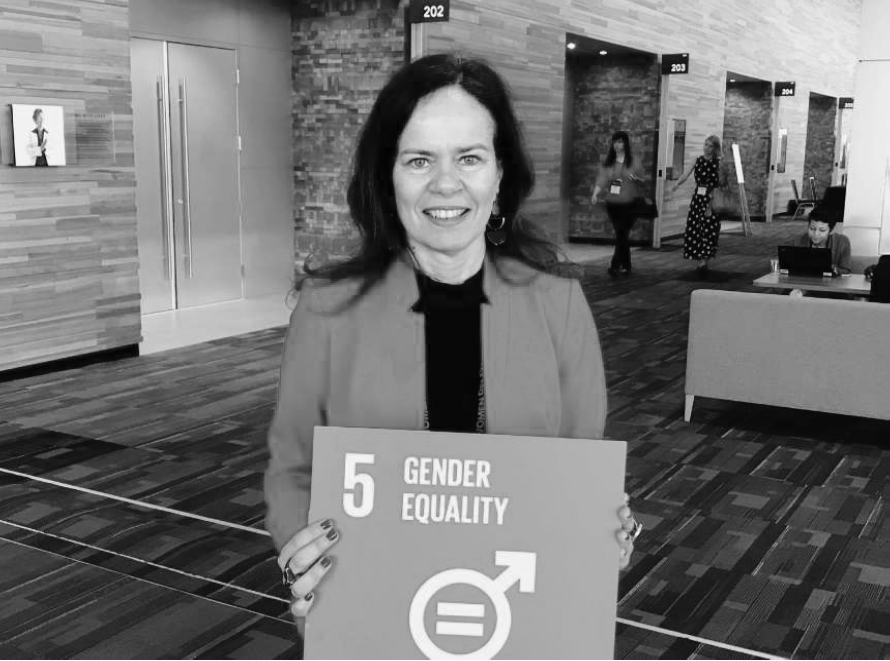
On the final day of our ‘Sixteen Activists or Organisations Around the Globe Fighting to End Digital Violence Against all Women and Girls‘ campaign, Kalliopi Mingeirou highlights the transformative power of the annual 16 Days of Activism campaign, why ending digital violence against women and girls has become an urgent global priority and what actions are needed to confront it.
Kalliopi Mingeirou is an experienced international affairs professional and currently Chief of the Ending Violence Against Women and Girls Section at UN Women. With more than 20 years of expertise, Kalliopi demonstrates a strong commitment to advancing gender justice and tackling gender-based violence worldwide. Before joining UN Women, she practiced law in Greece and held roles with various UN agencies and international NGOs, focusing on human rights, women’s rights and refugee protection across multiple countries in both development and humanitarian contexts.
UN Women is the United Nations entity dedicated to gender equality and the empowerment of all women and girls. Established in 2010 to unify and strengthen the UN’s work on gender equality, UN Women continues to put the rights of women and girls at the heart of global development. As the lead body on women’s rights and the secretariat of the UN Commission on the Status of Women, it works to transform laws, institutions and social norms to close gender gaps worldwide.
UN Women is the architect of the UNiTE campaign to end violence against women and girls, a global initiative held annually since 2008. As part of this effort, the 16 Days of Activism Against Digital Violence has run from 25 November to 10 December. UN Women also coordinates efforts across the UN system and partners with governments, civil society, and the private sector to drive progress in four key areas. This includes women’s leadership, economic empowerment, freedom from violence, alongside participation in peace, security and humanitarian action. Such work is essential yet increasingly under threat.
A 2025 survey conducted by UN Women with civil society organisations (CSOs) and women’s rights organisations (WROs) working to end violence towards women, captures the vast impact of recent funding cuts and reductions. 4% have halted initiatives aimed at ending violence against women and girls, while over 40% have reduced or shut down critical services such as shelters, legal aid, psychosocial care and healthcare support. Nearly 80% reported reduced access to essential survivor services and 59% observed growing impunity and normalisation of violence. Almost one in four were forced to pause or cancel prevention efforts entirely.
This context is inherently political. US President Donald Trump’s decision to freeze overseas aid has triggered some of the world’s largest aid organisations to axe thousands of jobs, potentially “decimating” the sector’s capacity to respond to future crises. Trump uses threats to cut aid as a tool of soft power to influence other governments, weaponising NATO defense demands and the US’s considerable economic leverage. For example, it has been reported that Prime Minster Keir Starmer submitted to Trump’s pressure to increase UK defense spending by slashing foreign aid.
This has widespread destabilising implications for the global economy, human rights, peace and political cohesion. It is therefore no surprise that 67% of respondents in the UN Women survey reported that they perceive a severe de-prioritisation of gender equality and EVAWG on political agendas. This stresses the urgent need of Chief Kalliopi Mingeirou and UN Women in championing women’s rights and calling for 16 days of activism to end digital violence.
In this interview, Kalliopi discusses the rising digital violence against women and girls; gaps in laws and enforcement; the rapid influence of AI and the manosphere; the responsibility of governments and tech companies to act; the vital leadership of feminist movements and civil society; and the power of the 16 Days campaign to shift public mindsets. She also shares examples of promising legal and technological progress, alongside UN Women’s ongoing role in advancing policy, accountability and digital safety for all women and girls.
This year’s 16 Days of Activism centres on ending digital violence against women and girls. Why was this issue chosen as a global priority at this moment?
Digital violence is rising at a pace that demands urgent action. During a year that marks 30 years since the Beijing Platform for Action, it became clear that digital safety is now central to gender equality. A lot of progress was made in the recent year, both at global and at country level and this issue is becoming a priority for many partners. But major challenges await, notably with the fast-evolving technologies including the rapid growth of artificial intelligence. And this starts by combatting impunity. Almost half of the world’s women and girls, nearly 1.8 billion people, have no legal protection against online harassment or stalking. Fewer than 40 percent of countries have any laws at all. If women and girls are not safe online, they cannot be safe or equal in any part of life. It is time to come together to accelerate action and call for stronger collaboration across all actors, starting with governments and the tech sector.
What are the most urgent challenges you see when it comes to addressing online violence?
The most urgent challenge is the lack of protection. Women and girls are facing abuse in an environment where accountability is rare. The anonymity of perpetrators, cross-border attacks, and weak enforcement leave survivors with no real way to seek justice. Women in the public life pay an even higher cost. One in four women journalists report receiving online threats of physical violence. While campaigning, up to 4 in 10 women candidates in local elections experienced gender-based negative discourse, hate speech and disinformation on social media. The rapid spread of misogynistic content through manosphere networks is shaping attitudes and making online hate seem normal. AI is accelerating these threats by making abuse faster, cheaper, and harder to trace.
The campaign calls on governments, tech companies and individuals to act. What policy and accountability measures are most urgently needed right now to combat digital violence?
Governments need to close the protection gap by criminalising digital violence, including deepfakes, online threats, doxing, and image-based abuse. They must enforce existing laws and strengthen personal data protection. Tech companies need to take responsibility for the worlds they have built. This means safety by design, stronger content moderation, rapid removal systems, and transparent reporting of how they enforce their rules. These platforms cannot continue to profit while women and girls bear the cost of harm. Individuals also have power. Choosing not to share a leaked image, reporting abuse, and challenging harmful behaviour all help shift norms.
What role does UN Women see for feminist movements and civil society in driving change online and offline? How is the campaign supporting these groups?
Feminist movements are at the forefront, from where they have been raising the alarm for decades now. They identify trends early, document emerging forms of harm, and advocate for stronger laws and safer platforms. Many of the major global advances, from the Global Digital Compact to digital literacy training and data collection, emerged from the work of women’s rights organisations. Through the ACT Programme and the 16 Days campaign, UN Women supports these groups and women human rights defenders with training, funding, digital security support, and international visibility. Their leadership ensures that solutions stay grounded in the realities women and girls face every day.
With nearly one in three women experiencing violence in their lifetime, and a quarter of adolescent girls facing abuse, how can the 16 Days campaign shift mindsets and inspire sustained action?
The campaign connects statistics with lived realities. Behind every number is a girl whose fake nude images circulate at school or a woman forced off social media by threats. By showing the scale of harm and the human cost, the campaign pushes people to see digital violence not as “online drama” but as a serious human rights issue. Clear actions give people a way to respond. Each share, each conversation, each demand for accountability helps break the silence. When people understand that digital violence restricts women’s safety, mobility, voice, and opportunities, they begin to treat it like the crisis it is.
Can you highlight any promising examples of progress, that show what’s possible when real action is taken?
Several global advances point to what is possible. Laws are beginning to evolve to meet the challenges of technological change. The UK’s Online Safety Act, Mexico’s Ley Olimpia, Australia’s Online Safety Act, and the EU’s Digital Services Act and AI Act show how new reforms are taking shape. As of 2025, through its Global Database on Violence against Women and Girls, UN Women tracked that 117 countries reported efforts to address digital violence. And yet, these efforts remain fragmented for a challenge that crosses borders.
At the global level, the Global Digital Compact set the first UN-wide benchmarks for digital safety, and the UN Cybercrime Convention created a path for cooperation across countries. The UN General Assembly also adopted a landmark resolution on violence against women in digital environments. On the technology side, new tools are emerging to detect manipulated images and filter abuse, and apps are helping survivors reach emergency support faster. These examples show that progress is possible when governments, platforms, and civil society act with urgency.
What are your hopes for ending digital violence towards women and girls and the part UN Women will continue to play in such a complex task?
We want a world where women and girls can speak, learn, lead, and thrive online without fear. Ending digital violence means building systems where women’s rights are protected, where hateful content is not rewarded, and where safety is built into technology from the start. UN Women will keep driving global standards, pressing for strong laws, supporting feminist movements, developing tools for the police and justice sectors to be responsive and working with tech companies on accountability and safety. This is complex work, but progress is possible. Every norm we shift and every protection we strengthen moves us closer to a digital world where women and girls are safe, respected, and able to participate fully.
Author Bio
Dr. Josie West is Head of Research and Communications at Image Angel, with digital political economy expertise in platform work, image-based abuse and digital social justice issues.