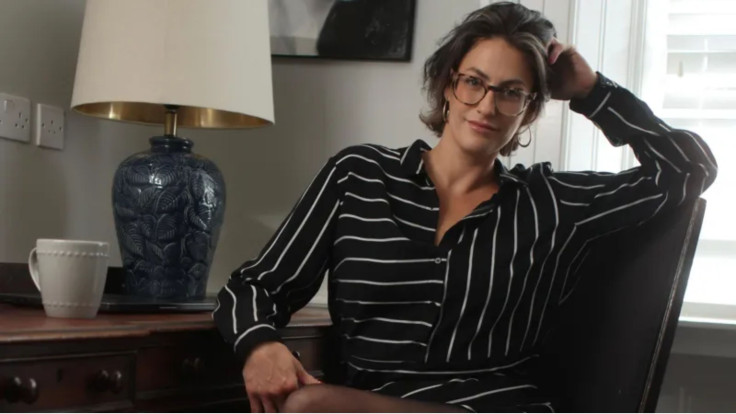


On day three of our ‘Sixteen Activists or Organisations Around the Globe Fighting to End Digital Violence Against all Women and Girls‘ campaign, Elena Michael discusses how the #NotYourPorn movement grew from a need to create space for survivors and champion s**workers’ rights.
Elena Michael is the co-founder and director of #NotYourPorn, as well as an award-winning campaigner and activist. Founded by Kate Isaacs after a friend’s intimate images were stolen and uploaded to Pornhub, Elena joined the campaign from its outset in August 2019. #NotYourPorn emerged in response to the lack of accountability and regulation facing porn platforms that host non-consensual content.
The campaign has since grown into a powerful movement challenging image-based sexual abuse (IBSA) and the systems that enable it. Not Your Porn advocates for survivor-centred, consent-based policy; pushes for stronger legal protections; works with industry to promote safety-by-design; and raises awareness of all forms of IBSA. At its core, the campaign seeks to ensure that survivors – including s**workers, young people and non-consenting adults – are respected, supported and involved in shaping the laws and platforms that affect them.
Elena studied English Literature and later completed a Graduate Diploma in Law and is now finishing her Bar training. Her background includes behavioural science, humanitarian aid, women’s health and human rights. Passionate about collaboration, she loves meeting new partners and learning from others. She has been working successfully with partner organisations to ensure online violence against women and girls is properly recognised in the Online Safety Act.
Winning the Future Legal Mind Award has boosted her confidence to speak openly about her advocacy, strengthened her campaign’s visibility and supported her academic and professional applications. Passionate about empowering other aspiring lawyers, Elena encourages students to enter the competition, articulate what drives them and highlight how their work contributes to addressing key legal issues.
In this interview Elena talks about enabling survivors to become activists, platform accountability, the belittling of the digital violence towards s**workers, polarising attitudes, the myth of the “perfect victim,” s**workers’ rights and the need for proactive approaches which protect ALL victims.
What motivated the decision to build the #NotYourPorn movement?
It wasn’t really an active decision to build Not Your Porn, the movement grew because there was an urgent need to create a space for survivors. Not Your Porn grew not only to offer practical support, but also to facilitate survivors to campaign. So many survivors of image-based abuse become campaigners because of their horrific experiences navigating the lack of platform accountability and their traumatic interactions with law enforcement. The system supposed to protect them has failed them; they end up with a wealth of knowledge/experience of the system’s gaps and loopholes because the burden has been placed on them to become their own advocate. Most have never received justice and campaign because they never want anyone else to go through what they have gone through. We are indebted to survivors for taking on this role to make change for the benefit of society. In fact, this is also the origin story of Image Angel.
How does digital violence manifest towards s**workers?
Not Your Porn’s remit is tackling image-based abuse. S**workers face image-based abuse like any other person but because it is sometimes done in the course of their profession, the abuse they face is belittled. Additionally, due to a lack of employment protections, s**workers can often face exploitative practices from platforms, production companies and other professionals seeking to take advantage of the gaps in s**workers’ rights for financial gain.
What has your experience been like working to build a movement that advocates for s**workers in the digital violence space? Have you encountered any specific challenges or barriers in this work?
There are very strong opinions about s**work which are often polarising and ultimately harmful to the movement. Furthermore, there is a divisive narrative of a “perfect victim” when it comes to survivors of any form of sexual violence (online or offline) which means anyone that doesn’t fit what people think a survivor should look like isn’t considered “worthy” of protection. These are huge challenges in advocating for s**workers’ rights. There shouldn’t be a trade-off of rights when it comes to tackling image-based abuse and every survivor is worthy of respect and protection.
What needs to change on a policy, platform and societal level to address digital sexual violence in the s**work community?
This is such a nuanced and complex question that it would be irresponsible to simplify it too much. However, it is evident that we need to work to shift attitudes towards digital violence aimed at s**workers. The loud viewpoints reduce the discussion to either conflating s**work with coercion/trafficking, or that violence is “just part of the job.” Of course, there are links between trafficking and the s** industry and working to combat this is important, but it is not the full picture and doesn’t mean all s**work is non-consensual. Similarly, there are many jobs, like tradespeople for example, that have associated dangers or risks. We don’t tell a builder on a building site it is “just part of the job” if one of them falls off some poorly assembled scaffolding. S**workers deserve the same health and safety protections, as well as employment rights as any other worker. We need to start to dismantle these attitudes that pervade policy, platforms and society, to be able to address digital sexual violence in the s**work community.
What are your hopes for ending digital violence towards women and girls and the part the Not Your Porn will continue to play in such a complex task?
At the moment, it feels like we are constantly playing catch up. The approach, in the UK and globally, is reactive instead of proactive. I hope that the mindset will change and law and policy makers will see the importance of creating a comprehensive system of preventions and protections rooted in survivors’ lived experience. Not Your Porn will continue to champion survivor voices and do everything we can to expand our work so that we can advocate for every survivor.