
On day thirteen of our ‘Sixteen Activists or Organisations Around the Globe Fighting to End Digital Violence Against all Women and Girls‘ campaign, Miss Ethiopia 2025 discusses her advocacy across beauty pageants, community spaces and the UN Human Rights Council, alongside the She Leads Programme and why centring girls’ and young women’s voices is critical.
“My activism began long before I even had the language for it. I grew up with parents who encouraged me to dream boldly,” Ethiopian human rights activist, Felicity Feleke, explains. At just 22-years-old, it’s evident that encouraging dreams in young girls, especially those that might break norms, can have a powerful impact.
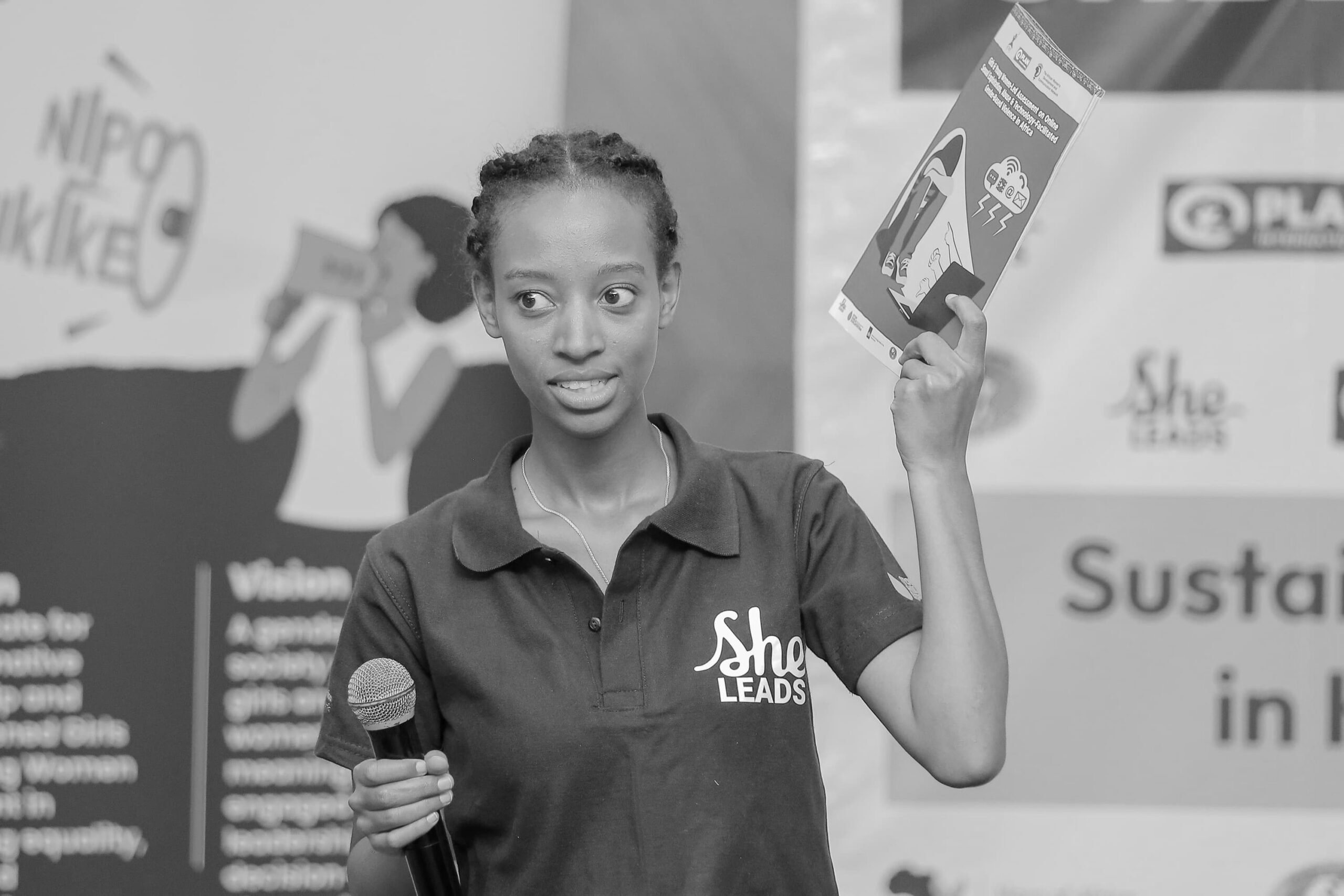
In 2025, Felicity won Miss International Ethiopia in 2025 and represented her country at Miss International 2025 in Japan. She served as a She Leads Young Woman Advocate of Ethiopia, which took her from grassroots advocacy to shaping global policy at the UN Human Rights Council. The She Leads Programme is run by a consortium of international feminist and child-rights organisations. It strengthens the leadership of girls and young women and supports their advocacy on gender norms, political participation and technology-facilitated violence in Africa and the Middle East.
As a She Leads Advocate, Felicity spearheaded a peer-led assessment into the scale of technology-facilitated gender-based violence (TFGBV) experienced by girls and young women within seven different countries across the African continent. The report reveals pervasive online sexual exploitation and TFGBV, which is compounded by stigma, low digital literacy, limited legal protections and inaccessible reporting systems.
While graduating in Law, she has also gained legal experience at the Ethiopian Red Cross Society and the Ethiopian Human Rights Commission. She is a long-standing girls and young women advocate with The Yellow Movement, a youth-led initiative at Addis Ababa University that promotes dialogue on gender-based violence
Growing up in Ethiopia, Felicity realised that the dreams her parents encouraged her to nurture were not necessarily supported in her community: “I quickly learned how girls’ ambitions are often limited by societal norms, silence and everyday violence. There was a narrow box of what a woman “should” be one I was expected to fit into.” Felicity was grew frustrated with the normalisation of domestic violence and pressure placed on girls to “prevent the violation of their own safety.” This responsibility felt all encompassing: “how we dress, how we speak, how we simply exist. We were told to be measured, careful and untempting.”
Felicity refused to accept this narrative. Rather, it fuelled the dreams her parents planted, to “be part of a generation that challenges and transforms this reality not just for myself, but for every girl who is told to shrink herself to survive.”
In this interview Felicity talks about the transformative impact of the She Leads Programme on her leadership, and why centring girls’ and young women’s voices is essential to addressing online exploitation and technology-facilitated abuse. She reflects on key findings from the recent peer-led assessment, the emotional and social toll of digital violence and the failures of reporting systems. Felicity also discusses her advocacy in pageants, community spaces and the UN Human Rights Council, the context in Ethiopia and the need for urgent change.
What first inspired your journey into activism, and how did your involvement with the She Leads Programme help shape your leadership and advocacy work?
Joining the She Leads Programme was the moment that transformed my passion into structured advocacy. It gave me the tools, mentorship and platform to amplify my voice. It also taught me that leadership is not about speaking the loudest, it’s about creating space for other girls to speak, to be heard and to be believed. Through She Leads, I learned how to turn lived experiences into evidence-based advocacy and how to engage decision-makers with confidence.
You played a key role in initiating and conceptualising the recent assessment on Online Sexual Exploitation and Abuse and Technology-Facilitated Gender-Based Violence (TFGBV). What motivated the idea for this project, and why was it important to centre girls’ and young women’s voices?
This project came from a very real sense of urgency. Across Africa, digital violence is rising faster than our systems can respond, yet the people most affected, girls and young women, often lack the digital literacy needed to navigate online spaces safely, and they are rarely consulted in the decisions that shape those spaces. Many of us have personally experienced, or watched our peers experience, shame, blackmail, silencing and complete withdrawal from the digital world.
My initial attempt was to map the legal countermeasures available for accessing justice and the preventative tools social media platforms claim to offer. I wanted to educate myself and the girls around me. But I quickly confronted a painful reality: digital violence is widely dismissed as a “luxury problem,” something girls could supposedly avoid by simply going offline. Yet for today’s youth, existing in digital spaces is not optional, it is essential for education, expression and opportunity. I wanted to create a project that didn’t just analyse the issue from a distance but listened directly to the girls living it, led by the very people affected.
Centring our voices was non-negotiable. I firmly believe we are the experts of our own experiences, and our insights must drive solutions, policies and platform accountability. That was what the She Leads programme rooted in (we often said “ Anything for us without us is against us”) and through the She Leads network of girls, young women advocates and partner organisations, that idea evolved into an impactful project and into powerful evidence for girls and young women to advocate with.
What were some of the key findings or insights from the assessment that stood out to you, particularly around the impact of digital violence on young women and girls across Africa?
Several findings stood out profoundly: Digital violence is normalised, especially for girls. Many respondents described it as “part of being online,” which shows how deeply the problem has been accepted instead of challenged. Blackmail and non-consensual image sharing are rampant, and they disproportionately affect school-aged girls and young women.
Reporting mechanisms are failing. Platforms remove content inconsistently, and survivors often face victim-blaming from their communities. The psychological impact is severe. Girls reported anxiety, trauma, withdrawal from school, and complete retreat from digital spaces which ultimately limits their rights to expression, education and participation. Despite this, girls are not passive victims; they are developing strategies, peer-support networks and digital resilience. They simply need systems that match their courage.
What have you learned from advocating in different contexts, such as Miss International, your community, or at the UN Human Rights Council?
The two biggest lessons I’ve learned from advocating in such diverse spaces are, first, that the strongest advocacy is both evidence-based and rooted in lived experience, and second, that while the message must remain consistent, the language must adapt. At Miss International, I learned the power of connecting policy issues to real human stories. Pageantry reminds you that empathy can move people just as effectively as data.
In my community, I learned that meaningful change starts at the grassroots, and that solutions must fit cultural realities to truly work. At the UN Human Rights Council, I saw firsthand how powerful girls and young women voices can be in global decision-making spaces. When you speak with evidence and conviction, even the most established policymakers listen. Across all these spaces, I’ve learned that advocacy is never about the platform, it is always about the purpose.

Felicity represents Ethiopia as a She Leads Young Woman Advocate
Are you seeing increased awareness and action around emerging forms of digital abuse toward women and girls in Ethiopia?
Yes, awareness is slowly growing, especially among young people, civil society and some policymakers. Conversations around digital safety are happening more openly than before, and survivors are starting to challenge the stigma that once silenced them. However, action is not yet proportional to the scale of the problem. Legal frameworks are still catching up, platform responses remain inconsistent, and public understanding of digital consent and privacy is limited. And with the concerning increase of anti-rights movements and trends, digital violence, particularly targeting women rights’ activists has increased alarmingly. Awareness is the first step, but now more than ever we need coordinated and sustained action to truly protect girls online.
What needs to change on a policy, tech platform, or societal level to address digital sexual violence?
On a policy level, Ethiopia and many African states need stronger, survivor-centred cyber laws that criminalise online sexual exploitation explicitly, clearly and enforceably. We need faster, trauma-informed reporting and response procedures. And these laws and policies must be created in consultation with girls and young women themselves.
For tech platforms, we need stronger proactive detection of abusive content, not just reactive removal. The existing and new safeguarding methods must also contain region-specific moderation that understand African contexts and languages. Additionally, we must demand stronger transparency and accountability for harmful algorithmic amplification.
On a societal level we must break the culture of victim-blaming. Teach digital literacy, including consent, privacy and healthy online behaviours, starting from schools. Support parents and communities to understand digital harms without resorting to controlling or punishing girls. Digital safety is not just a tech issue; it is a human rights issue.
Looking ahead, what are your hopes for ending digital violence toward women and girls, and how do you see yourself and other young women across Africa leading this movement?
My hope is for a digital world where girls can exist, speak, dream and lead without fear. A world where safety is not a privilege but a basic right, because the tools meant to make our life more convenient must not be another tool to violate women’s rights. I see young African women leading this movement with the same bravery they show every day, by challenging harmful norms, shaping new research to bridge the gap in data, holding platforms accountable and driving innovation from a feminist, rights-based lens.
As for me, as a graduating law student I will continue advocating at the intersection of human rights law and technology, pushing for evidence-based policy change, strengthening access to justice, amplifying young women’s voices and playing my part in building systems that protect, not punish, girls.