
On day eleven of our ‘Sixteen Activists or Organisations Around the Globe Fighting to End Digital Violence Against all Women and Girls‘ campaign, TBTT! activists reflect on feminist collectives in the Global South, political instability, the militarisation of technology and Big Tech accountability. They discuss how digital GBV undermines women’s and queer communities’ self-expression and political power, and how creative digital feminism offers resistance.
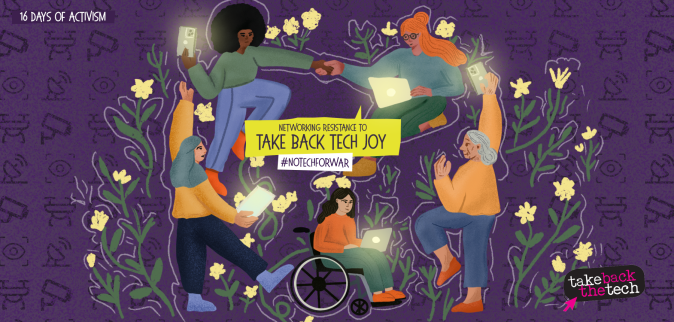
Image credit: Take Back The Tech! campaign image by Junaid Rana
This interview is based on collective responses from Erika Smith, based in Mexico, and the wider international team, including two long-time campaigners at TBTT, Archismita Choudhury, based in India and Florencia Goldsman, based in Argentina.
Initiated in 2006 by the Association for Progressive Communications (APC) Women’s Rights Programme, Take Back the Tech! (TBTT!) is a global feminist campaign, that mobilises women, girls and communities to use technology creatively and strategically to end gender-based violence.
In the early 2000s, TBTT! and feminist ICT advocates across multiple countries in the Global South were already observing how gender-based violence was beginning to take shape in digital spaces. They describe seeing the first signs of intimate-partner monitoring and control, image-based abuse, privacy violations and online harassment. These behaviours were recognised as early indicators that the violence women faced in the streets, workplaces and homes would inevitably surface online as well.
TBTT! activists understood that gender-based violence was a structural issue, so it was unsurprising that it would manifest on the internet too. Yet, at the time, many feminists still saw the internet primarily as a tool, and “did not yet consider it a political space of contestation.” Activists, policymakers and legislators were largely dismissive, insisting that online gender-based violence wasn’t “real,” and treating it as a distraction from the forms of violence women publicly protested every 25 November on the International Day for the Elimination of Violence Against Women.
TBTT! explain that the campaign’s aim was to raise awareness about technology-facilitated gender-based violence and help prevent it. They tried to cultivate a sense of playful curiosity around technology, encouraging women’s human rights defenders and activists to build tech skills and explore how digital tools could deepen feminist organising against gender-based violence. The intention was never to demonise technology or push people away from a space that, for many, was only beginning to open up. They didn’t want the internet to become another “dark alley” women were taught to fear.
At the same time, the campaign sought to do several things at once: to highlight women’s long-standing roles in creating and shaping technologies; to promote copyleft principles and open-source tools; and to make the campaign itself available for anyone to adapt its images, messages and TBTT platform to their own communities and languages. They emphasise how significant this was at a time when creating digital content and accessing the infrastructure to share it widely were far more difficult than they are today.
In this interview, TBTT! campaigners discuss the challenges of political instability, Big Tech and operating internationally in the Global South, alongside protecting the anonymity of activists in hostile environments and the increasing militarisation of technology. They also explore global, regional and local activism; attacks on women’s political power through image-based abuse; threats to sexual expression and queer communities; Big Tech accountability; the power of creative digital feminism; and the intersectional nature of digital violence.
What has it been like building a global, collaborative campaign that tackles tech-related gender-based violence? Have you encountered any challenges?
“I joined the campaign in 2010. I felt no one had named it that way before; it was something that was an everyday part of our lives and could happen easily. In my particular case I could talk about it through playful tools using theater workshops and through colorful campaigns – sometimes ironic ones. Calling for participation in Latin America where there’s always a lot of creativity and protest, our campaigns weren’t just on the internet but also something you could do on the streets: in the parks with posters, spray-painting t-shirts… it was a multi-platform process not just offline or online… Initially it was a challenge to understand and adapt the content and issues to each context and how they are reflected in each place, and even in Latin America with its different languages in each country and each region. At first, too, the problem was being minimised. Today we see that it is a super well-recognised problem everywhere. Other challenges are campaigners’ safety: not exposing yourself, preserving data privacy, preserving anonymity, being able to propose an agenda that is not so much about being an influencer and individualistic buy-in to commercial social networks’ model.” – Florencia Goldsman, Journalist and TBTT campaigner, Argentina.
“It has been a hugely enriching experience, and we continue to build solidarities and partnerships across constellations of change — these constellations include activists, collectives and organisations across various areas of tech-related gender-based violence… and also tech-related gender-based agency. We keep learning from each other, and growing together. A difficult challenge is the worsening political situation in different countries that advocates are in — leading to internet shutdowns, gendered violence, and lesser space for democratic expression — which in turn lead to slower change and increased danger for progressive actors, no matter where they live.” – Archismita Choudhury, TBTT campaigner, India.
At first the campaign encouraged people to move out of their comfort zones and explore the possibilities of technology. It pushed campaigners to open up discussion locally and begin to see the internet as a political space and women and gender diverse people as shapers and stakeholders in that space, not just “users.” Challenges have morphed over time, especially as so much online activism and organising was taking place on social media controlled by big tech companies whose bottom line is profit, not addressing the violence happening on their platforms. Although social media is not the only site for TFGBV, activist expression is curtailed now through censorship, takedowns and shadowbanning, in addition to monetisation of hate speech.
Take Back the Tech! Empowers local organisers to adapt campaign strategies to their context. What kinds of support, tools or resources does the campaign offer to those working on the ground?
“We call on illustrators to not only design and put their creativity to work, but also to create broad illustrations that could be reused by other people in other campaigns. We put materials, letters, games, audios, and memes at their disposal, as well as constantly creating and translating content to be reused in order to always open up discussion and debate. I think that in this way the campaign can be adapted and people can join in with everything we were doing.” – Florencia
The campaign tries to bring a provocative feminist frame to TFGBV every year, informed collaboratively by local contexts and distinct realities. For example, this year the campaign looks at the intersections between TFGBV and the increasing militarisation of technology and how this plays out on women and gender diverse people’s lives and bodies, especially in specific conflict contexts. It’s important to bring feminist analysis to technology that is frequently only seen as something that abusers use: encryption, anonymity. In the early years, to help build evidence of TFGBV, campaigners around the world fed into a crowd-sourced map of incidents demonstrating the structural and global nature of the problem while offering glimpses into local context and experiences of TFGBV. TBTT offers open-source infrastructure, informational resources and games that can be used by activists on the ground, with an option for more tailored guidance or referral via email. TBTT DJs’ curate special collections of feminist resource recommendations around TFGBV, disability rights, the environment and AI. Some years TBTT was able to offer small grants to campaigners to carry out local activities.
GBV is a serious issue that is not going to disappear any time soon because it is so entrenched and normalised in our societies. Take Back the Tech! over the years has tried to be playful and sometimes irreverent in support of activists’ resilience and wellbeing. Although global campaigning is virtual and mostly async, the campaign also offers forums and Feminist Learning Circles to ensure that we can connect, learn, laugh and share in real time. This year’s campaign will feature the Feminist Learning Circle “Your ex is not a hacker, but you can be!” as part of our work against stalking.
Why is a decentralised, global approach so important when addressing technology facilitated violence against women and girls? What power lies in collective action across borders.
“The issues we work on manifest across borders; the technologies used against us and the tech that we use, rarely changes its tactics or methodologies based on geography. We must recognise the global-ness of the problem, while being rooted in the localised nature of solutions and support. There is power in such action because then we become partners in struggle, instead of distant allies.” – Archismita
“There are differences in each context, although globally we find commonalities. Collective action crosses borders not just because of all this violence, but also all the creativity and momentum and desire to share that drives the campaign and decentralization.” – Florencia
In addition to strength in numbers making the reality of TFBV undeniable, collective action meant putting on pressure at local, regional and global levels, affecting change in policies, legislation, norm-setting and in tech company practices. But it also has meant uplifting feminist analysis and survivor experience, questioning that violence on the internet is inevitable or the only thing that shapes women and gender diverse people’s experience of being online.
Through your campaigns, how have you seen image-based sexual abuse and other forms of digital violence differ across regions or cultural contexts?
“Image based sexual abuse is definitely context specific, although it is an example of TFGBV across the world. For example, in highly conservative contexts, you may not need nudity in media for it to become image-based sexual abuse. Gendered disinformation is another manifestation playing out in distinct forms. It relies on stereotypes and prejudices to reduce the credibility of women in the public eye, such as women human rights defenders (WHRDs) and their work across the globe. Attacks can differ geographically. In one area, it may be enough to say that the WHRD is too friendly with men or drinks alcohol, while in other areas a WHRD may face accusations of being promiscuous and/or deepfakes that show her nude. Of course, in some countries surveillance is also very normalised and WHRDs may face private conversations and messages being leaked, and whether they are fake or not becomes another matter altogether.” – Archismita
“Circulating these violent possibilities creates further violence…. journalists are seeing their image recreated by artificial intelligence to expose them in sexual situations that, though artificially created, is also violence. At different levels, we are seeing aggression and its reproduction in the business model of hate that surrounds violent image creation, also intensifying in recent years with the governments we have.” – Florencia
Take Back the Tech is constantly evolving and learning from the broader ecosystem of activists working against TFGBV, including feminist helplines, anti-violence shelters, feminist internet researchers, digital rights advocates, feminist tech trainers, queer activists and policy geeks. We’ve seen the increase in the risk of physical harm as stalking and surveillance techniques become ever-more sophisticated, thanks to new tracking devices, facial recognition and government spyware tools, tested in warzones, becoming easily available on the open market. Convincing extortion and sextortion demands and image-based abuse, enhanced with AI, crash down in waves on different communities thanks to certain apps increasing in popularity in one region after another. But feminist techies are forever sharing strategies, alerting to any new tactic, finding creative ways to dodge attacks or nullify them through solid digital safety practice.
Is there a local campaign or action from your network that has inspired you recently – something that stood out in terms of impact, creativity or solidarity?
What is interesting about the broader ecosystem of advocates working against TFGBV is how local campaigns may have started around the 16 Days or interconnected with Take Back the Tech! at some point, they are now flourishing and deepening prevention work, advocacy and accompaniment for survivors directly in their communities, after long ago debates and playful provocations. One beautiful, participatory campaign led by Luchadoras and Sandia Digital in Mexico some years ago was supported by the Womanity Foundation to “localise” Take Back the Tech. Since that time, Luchadoras’ work has been strengthened by their country research and fed into ongoing advocacy, investigation and their feminist helpline, for which they are currently developing a bot tool to support them in responding to heavy helpline demand. This year’s campaign will take a closer look at Luchadora’s bot testing.
There have been many incredible campaigns through the years around 16 Days of Activism, International Day Against Homophobia, Biphobia and Transphobia, and other significant days that prioritised collective organising and solidarity. Instead of naming particular campaigns, here are some organisations/collectives readers could follow for regular information and resources from diverse contexts: Body and Data from Nepal, Wougnet in Uganda, and Pollicy too — based in Uganda but working across Africa, Point of View from India, Amarantas, based in Chile, to name just a few.
What changes are urgently needed at the platform, policy and societal level to better address digital violence against women?
Protectionist legal response continues to be a major challenge, as governments attempt to address TFGBV and regulate platforms but frequently pass laws that instead legalise silencing of dissent, limit access to information, or attack sexual expression, especially that of queer communities. Tech platforms have recently been back-pedaling commitments made respecting human rights, privacy by design, transparency and incorporating civil society and especially survivor groups in policy decisions. Responsive, holistic, careful policy incorporating education and health sectors as equally as important as gender specialists, national cybersecurity or criminal prosecution.
“A shift in the core values that currently run Big Tech companies or AI corporations would be much more helpful — values of transparency, informed consent, centering the voices of marginalised people and data ownership coming back to us… is a start.” – Archismita
What are your hopes for ending digital violence towards women and the part Take Back the Tech! will continue to play in such a complex task?
“Digital violence towards women and girls is inextricably tied to digital violence against other marginalised peoples and vulnerable communities across the world — queerphobia, ableism, racism, casteism and classism give rise to digital violence that exists on its own, as well as intersects with online violence against women and girls (and each other). One kind of digital violence (here, against women and girls) cannot exist without digital violence in general, and a world that rewards such violence — against each other, and used by States and corporations against us. So, the underlying and guiding hope for us all is ending the values that push this violence through, and reward it.
Take Back The Tech! will continue to do its part, through naming violence and building agency for all of us who still believe in the hope and dream of a world where technology is not extractive — physically and digitally.” – Archismita
“One of the things that I love about Take Back the Tech is that it is inherently hopeful and celebrates feminist creativity and strength. When you start to look at violence in general you necessarily become protective, you necessarily get put on the defense. What we found again and again after exploring, understanding and unpacking different ways that TFGBV is affecting our lives, if you make space for play and creativity with tech, possibility prevails. We did a series of Feminist Learning Circles on how to make bots and as people built their bots right away they wanted to use them to attack online misogynists, bombard them with feminist quotes and stats about GBV. Invariably the next idea was rather how can we uplift our voices, how to celebrate each other, how to connect with each other more. The art of creation and celebration and hope is always going to be more powerful than the violence that tries to tamp it down. That’s why being joyful and exploring technology, exploring possibility as we address the very structured violence and persistent attack helps us to always say this violence will not be our reality, we cannot deny it but we will not normalise or accept it.” – Erika Smith, TBTT co-coordinator, Mexico.
Find Take Back The Tech at:
takebackthetech.net
Twitter: takebackthetech, dominemoslastic
Mastodon: https://mastodon.social/@DominemoslasTIC
Bsky: @takebackthetech.bsky.social